Few things are more annoying than an RCD that keeps tripping. One moment you’re boiling the kettle, the next you’re in the dark, muttering under your breath and heading for the fuse board.
Earth Leakage: Why Does My RCD Keep Tripping?
The good news? There’s usually a logical reason behind it - and it often comes down to earth leakage.
Checking for Earth Leakage
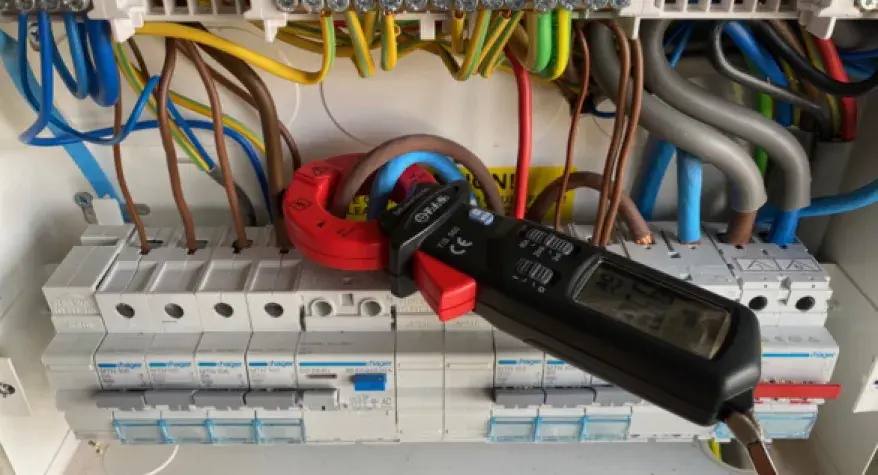
Electricians have a handy tool for this: the clamp meter. By clamping around the main meter tails (or the incoming tails at the fuse board, the RCD tails in a split load board, or even a single circuit’s live and neutral conductors), we can quickly see how much current is leaking to earth.
If the clamp shows excessive leakage, the next step is to narrow it down. That means clamping around the live and neutral of each RCD in turn, looking for anything over 30% of the rated trip current. For a 30mA RCD, that magic number is 9mA. In practice, though, we like to see it well below that.
How Much Leakage is Too Much?
A standard 30mA RCD will usually trip somewhere around 26–27mA. That’s its job. But if the combined leakage across your installation is already sitting above 9mA, you’re edging closer to nuisance tripping territory. Think of it as walking around with a full glass of water - one small bump, and it’s spilling over.
Intentional vs. Unintentional Leakage
Not all earth leakage is a problem. Some is entirely intentional, built into appliances as part of their safe operation. Many modern devices rely on a small amount of earth leakage to function correctly.
Unintentional leakage, on the other hand, is the troublesome kind. This might be caused by degraded insulation on old wiring, dampness getting into cables, or any number of other installation issues.
Tracking Down the Culprit
So how do you figure out what’s causing your RCD to trip? The detective work usually starts by switching circuits off one at a time until the leakage drops. Once you’ve narrowed it down to a single circuit, you can then unplug appliances one by one. If the leakage disappears when the tumble dryer or fridge is unplugged, you’ve found your suspect.
If unplugging everything makes no difference, then it’s likely down to unintentional leakage in the wiring itself. At that point, an insulation resistance test is needed to confirm the condition of the cables.
Managing Earth Leakage
Once the cause has been pinned down, there are several ways to keep leakage under control:
- Balancing circuits between RCDs so no single device is overloaded.
- Upgrading to RCBOs (where each circuit has its own protection, reducing the chance of one fault tripping half the house).
- Testing appliances and repairing or replacing those with excessive leakage.
- In stubborn cases, rewiring faulty cabling may be the only long-term solution.
In Summary
If your RCD keeps tripping, it’s not being awkward - it’s doing its job. Earth leakage is often the reason, and with a systematic check it’s usually possible to identify whether it’s an appliance, the wiring, or simply too much leakage spread across the installation.
At RW Electrics Ltd, we don’t just reset the switch and hope for the best. We investigate, diagnose, and put things right - so your RCD protects you without becoming a daily nuisance.
How RW Electrics Ltd Can Help
If your RCD is tripping more often than the kettle’s boiling, it’s a sign that something isn’t quite right. Whether it’s a tired old appliance, a wiring issue, or simply too much earth leakage across your circuits, it’s worth getting it checked.
At RW Electrics Ltd, we can test your installation, track down the cause, and recommend the best fix - whether that’s balancing circuits, fitting RCBOs, or upgrading old wiring.
Based in Shrewsbury and covering the surrounding areas, we’re here to keep your electrics safe, reliable, and nuisance-trip free.
Call Ray today to book an RCD inspection and enjoy the peace of mind that comes with safe, dependable electrics.