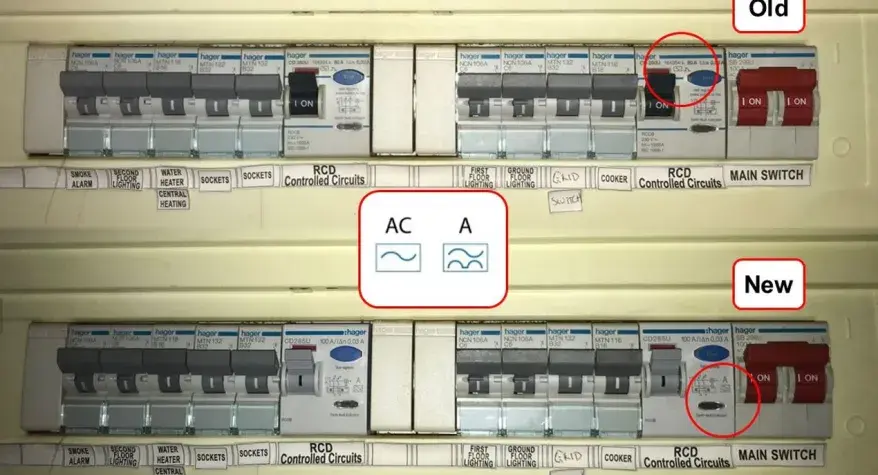
Both RCD devices in this house fuse board at a home in Shrewsbury were upgraded to comply with the current wiring regulations and safety guidelines.
Pay attention to the symbols printed on the front of the RCD device.
In most situations before any major additions or alternations can be made to circuits in a domestic dwelling – old generation “Type AC” RCDs must be replaced with the modern “Type A” now.
The RCD is a life-saving safety device, and as such, we always want to know that it will operate as intended if ever needed when an electrical fault occurs.
The early generation “Type AC” RCDs were highly effective protective devices, but they have proven to be less reliable in modern homes as a consequence of DC leakage and DC fault currents caused by modern electronic equipment. Subsequently new “types” of RCD have been developed now.
There is a prevalence of electronic equipment in most homes now – such as USB chargers, DC power supplies, Laptop power supplies, Appliances with electronic controls, and LED lights to name a few – which all use DC power and generate a pulsating DC current. So inherently there can be a build-up of DC current on the circuits with these devices operating.
This can lead to the “Type AC” RCDs becoming desensitized or “blinded” and the device may not operate within the required time, or in some instances may not even operate at all.
So since BS 7671 wiring regulations Amendment 2 – “Type AC” RCDs are no longer permitted to be installed for socket circuits, and they are only allowed to be installed for fixed equipment where it is known that there are no DC components.
You may be aware that changes to wiring regulations are not usually applied retrospectively.
However when additions or modifications are undertaken to existing socket circuits an assessment of safety has to always be made and the current wiring regulations considered, hence why this matter comes up frequently now when I am undertaking electrical work for customers.
If you would like more information about this please do not hesitate to get in touch.
Call Ray today to book a free visit or obtain free expert advice about this over the phone.